
In brief: With the same insulation thickness, rubber and PE foam are often thermally very similar. Rubber is usually more efficient for cold or damp pipes because its closed-cell structure and tightly sealed joints limit condensation more effectively. PE foam performs well in dry indoor areas, is easy to install and costs less. Thermal conductivity, thickness, fit and carefully sealed joints remain crucial.
Pipe insulation reduces heat loss, protects cold pipes from condensation and improves comfort in buildings. Rubber and PE foam are both closed-cell insulation foams, but they behave differently when exposed to moisture, temperature changes and installation conditions.
The more efficient solution therefore depends on more than the insulation material alone. Pipe diameter, wall thickness, thermal conductivity, surroundings and the quality of the joints determine how much energy you actually save.
When choosing suitable pipe insulation, start with the pipe's outside diameter and its installation location. Only then compare the material, thickness and installation method.
Main product comparison
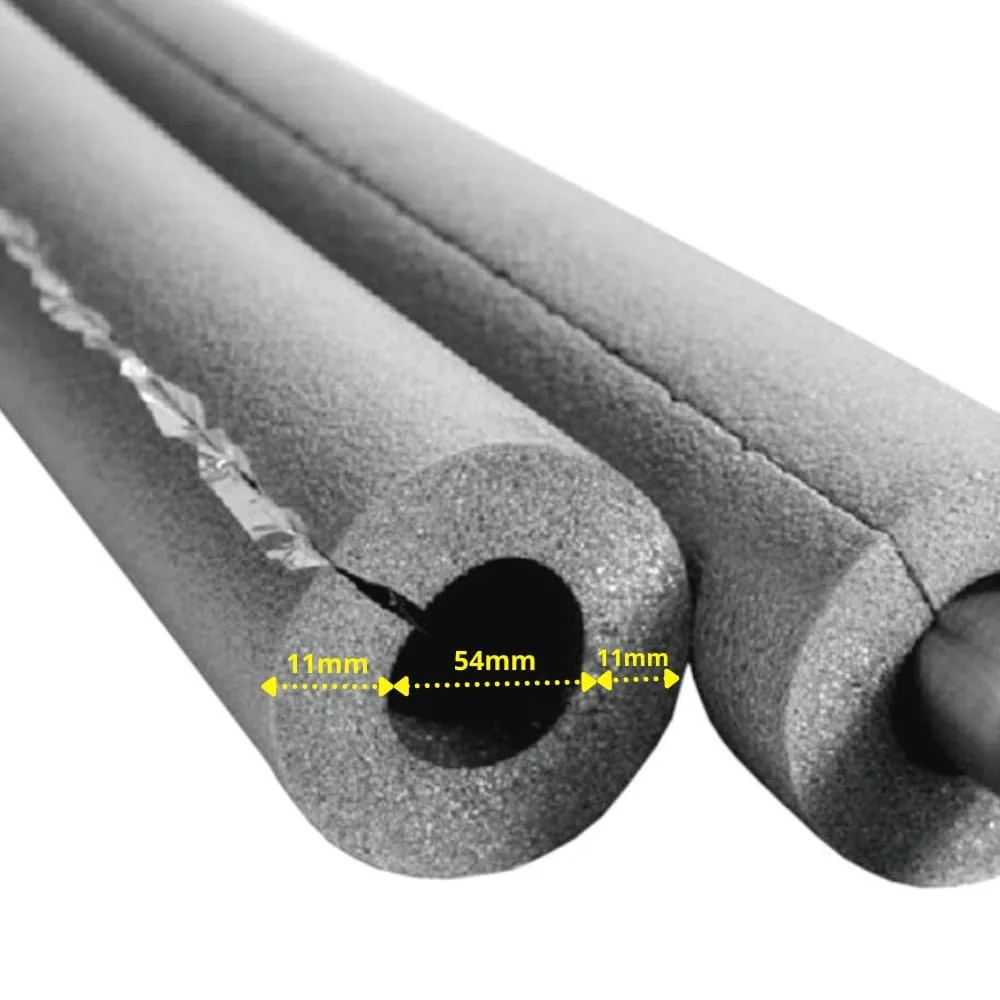
The AEROFLEX® SH XT pipe insulation is 2 m long, self-adhesive and made from flexible closed-cell foam rubber. The black version measuring 54 x 10 mm costs 11.99 EUR according to the product information and is in stock. It is suitable for pipes with matching dimensions and enables quick, airtight installation.
How do rubber and PE foam differ for pipe insulation?
Rubber pipe insulation consists of a flexible rubber-based foam. Its fine, closed cells absorb very little moisture and retain their shape even around bends, branches and irregular sections.
PE foam is based on polyethylene. The material is lightweight, usually slightly more rigid and can be cut to length quickly with a sharp knife. For straight pipe runs in dry indoor areas, PE foam is a simple and often cost-effective solution.
What are the benefits of foam rubber?
Its flexibility makes it easier to adapt to tight bends. If you do not permanently compress the material while fitting it, it can compensate well for uneven areas and keep the insulation snug against the pipe.
A closed-cell rubber structure slows the passage of water vapour. This is particularly important for cold pipes because moisture beneath leaky insulation reduces its insulating performance and can promote corrosion on the pipe.
Rubber can also be joined effectively with system-compatible adhesives and sealing tapes. The surface remains flexible, so the seam is less likely to open when the pipe moves slightly.
What can PE foam do?
PE foam is ideal for straight pipes and straightforward installation conditions. You can easily cut the pipe sections to size, fit them over the pipe and close the longitudinal seam with suitable tape or adhesive.
The material also has closed cells, but depending on the product, its water vapour barrier performance and dimensional stability may differ from rubber. Always check the specific data sheet rather than relying only on the general term PE foam.
PE is often sufficient in dry surroundings, for short pipe runs and at normal room temperature. In damp basement areas, unheated spaces or around cold-water pipes, the requirements for sealing increase.
Types of insulation foam at a glance
- Elastomeric or foam rubber: flexible, closed-cell and especially practical for bends, fittings and condensation protection.
- PE foam: lightweight, easy to cut and suitable for many straight heating and hot-water pipes.
- Mineral fibre: not flexible, but interesting for certain high-temperature and building applications; it usually requires suitable cladding.
- PUR or PIR elements: dimensionally stable and high-performing, but less flexible for small, intricate pipe sections.
When searching for pipe insulation materials, it is therefore important to consider not only the rated thermal conductivity, but also moisture behaviour, temperature range, installation and the available wall thickness.
Pipe insulation materials comparison: the key differences
| Criterion | Rubber | PE foam |
|---|---|---|
| Flexibility | Very high; adapts to bends and minor uneven areas | Good to moderate; especially practical on straight runs |
| Moisture and condensation protection | Strong when seams are closed and bonded correctly | Good in dry surroundings and with fully sealed joints |
| Installation | Easy on complex shapes; self-adhesive versions save time | Fast on straight pipes; cutting around bends requires more care |
| Material costs | Often higher, but durable in challenging conditions | Often lower for standard applications |
| Typical applications | Cold, heating and plumbing pipes exposed to changing conditions | Dry indoor areas and simple heating or hot-water runs |
“Insulation is only as effective as its weakest seam. The right material and seamless installation must therefore always go hand in hand.”
Which insulation reduces heat loss and condensation?
When it comes to thermal efficiency, the thermal conductivity of the specific product is the first factor to consider. At the same temperature and thickness, a lower lambda value means less heat flow through the insulation.
Always compare datasheets under similar test conditions. Thermal conductivity changes with temperature, bulk density and moisture. A blanket comparison between rubber and PE foam can therefore lead to incorrect results.
How much do wall thickness and pipe size affect heat loss?
A thicker layer of insulation reduces heat loss more effectively than changing materials within the same performance class. Thin rubber insulation is not automatically more efficient than a considerably thicker PE version.
Pipe size also plays a role. A larger pipe has a greater surface area through which heat can be lost. To achieve the same insulating effect, you therefore need a suitable wall thickness and a fully enclosed insulation layer.
Brackets, wall penetrations and flanges can also create thermal bridges. Cut the insulation neatly, bring it as close as possible to these areas and leave only the necessary maintenance areas exposed.
Why does rubber often have an advantage when it comes to condensation?
Condensation forms when the outside surface of the pipe falls below the dew point of the surrounding air. This mainly affects cold water, air conditioning and refrigeration pipes in warm or humid rooms.
Rubber slows the passage of water vapour and can be flexibly guided around bends. A neatly bonded longitudinal seam and tightly closed joints keep humid room air away from the cold pipe wall.
PE foam can also prevent condensation if you reliably seal all joints. However, small open gaps, crushed ends and unprotected penetrations are enough to allow moisture to get underneath the insulation.
What impact does sound insulation have?
Both types of foam dampen certain components of flow noise and structure-borne noise. Thanks to its elastic structure, rubber offers advantages when pipes transfer vibrations to brackets or building components.
However, pipe insulation does not replace complete plumbing sound isolation. For quiet installations, also use decoupled pipe clips, maintain sufficient distance from walls and ensure proper fastening.
Pro tip
Do not permanently compress rubber insulation when fitting it around bends. Cut short segments or mitres, bring the seam tightly together and bond the joints with an adhesive suitable for the system.
How do you identify the right pipe insulation for heating and hot water?
The installation location determines the right approach. For dry pipes in heated indoor areas, a well-fitting PE foam is often sufficient. In unheated basements, garages or utility rooms with high humidity, rubber offers greater reserves.
Which solution is suitable for heating pipes?
For heating pipes, protection against heat loss is the priority. A continuous layer of insulation keeps the heat in the pipe and improves the efficiency of heat distribution. To find suitable sizes, the heating pipe insulation range includes different diameters and wall thicknesses.
PE foam is often sufficient for straight, dry pipes. Rubber makes installation easier when there are many bends, tight clearances or changing temperatures.
Pay attention to the product specifications for the permitted temperature range. Not every type of foam is suitable for every flow temperature, proximity to heat sources or installation directly on fittings.
When is rubber suitable for cold water pipes?
For cold water pipes, protection against condensation is the main concern. Rubber is often the more robust choice because the material fits flexibly around the pipe and can be sealed effectively at transitions.
The same applies to pipes for air conditioning units and refrigeration systems. Protect the insulation layer against pressure points, as a crushed section becomes thinner and can fall below the dew point more quickly at the surface.
The rubber pipe insulation range offers various versions for this purpose. Choose the wall thickness to suit the pipe temperature, room humidity and available installation depth.
AEROFLEX SH XT alternatives for other pipe diameters
The main product covers a specific pipe diameter and insulation thickness of 54 x 10 mm. Measure the outside diameter before ordering, as the nominal pipe size does not always match the actual outside measurement.
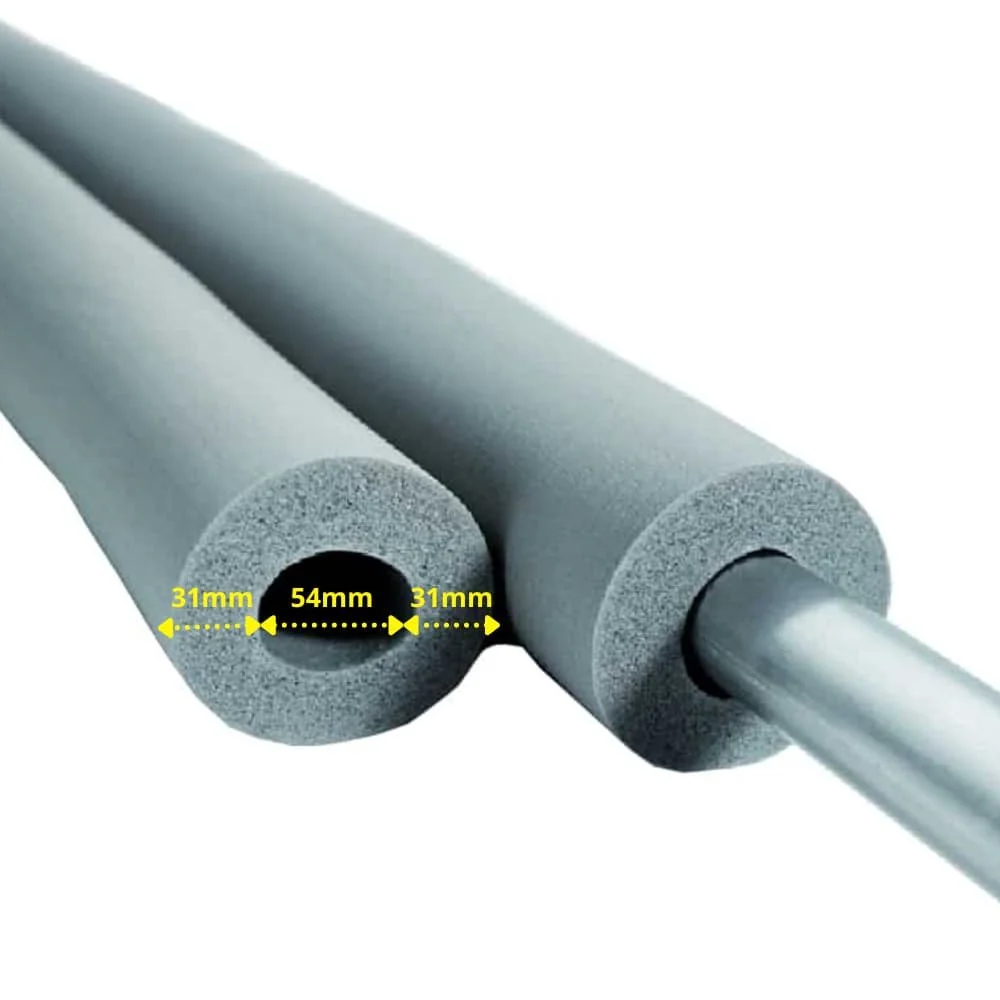
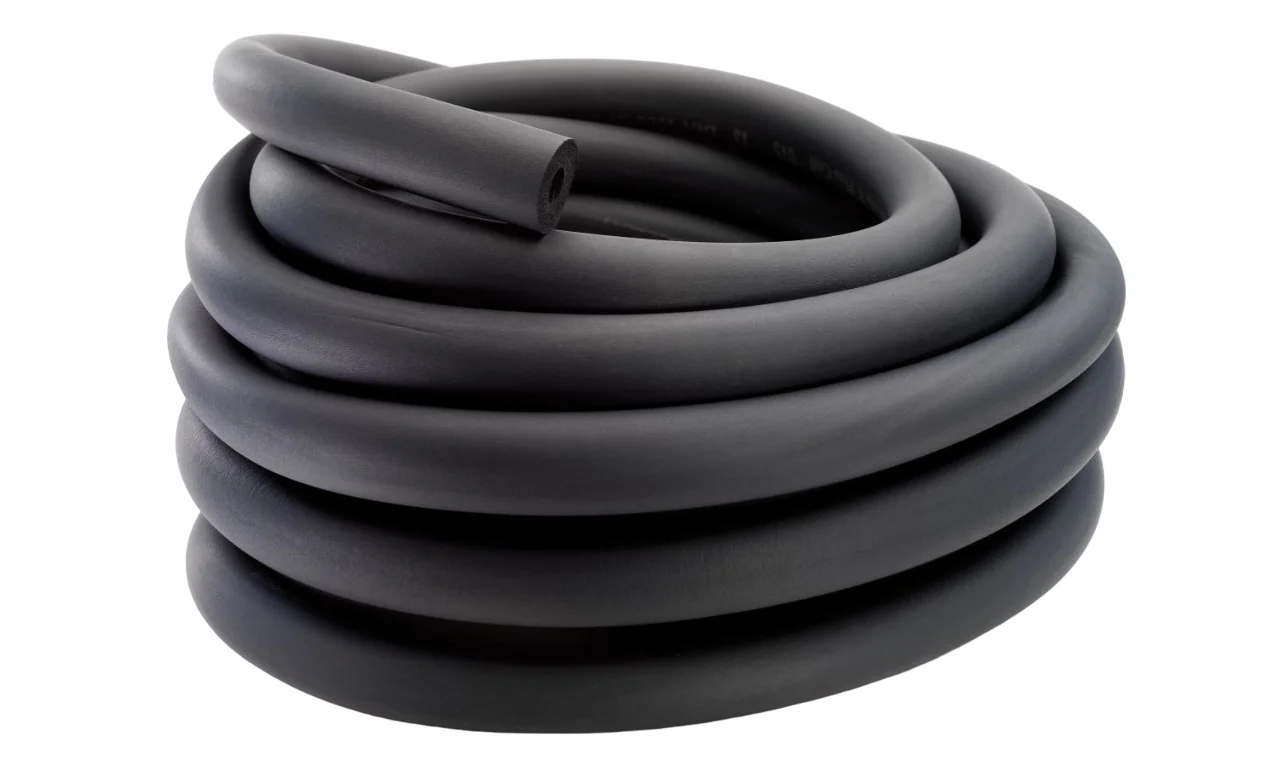
For long, narrow pipe runs, the
Important note
Do not cover components that need to be inspected, drained or serviced regularly. Leave flanges, isolation valves, safety fittings and detachable connections accessible according to the system requirements, or plan for removable insulation sections.
How do you install rubber and PE foam neatly?
Careful installation determines the actual insulation performance. Even high-quality foam loses effectiveness if the longitudinal seam remains open, the material is under tension or butt joints are misaligned and not sealed properly.
How do you measure the pipe and insulation?
Measure the outside diameter of the existing pipe with a calliper or determine it from the circumference. Divide the circumference by Pi to obtain an approximate diameter.
Do not rely solely on designations such as DN 15 or DN 20. Depending on the pipe material and system, the actual outside diameter may differ. Compare it with the internal dimensions of the insulation.
Also check the required wall thickness. 10-mm insulation saves space, while 20 or 30 mm provides more insulation reserve. The installation location must accommodate the chosen thickness without crushing the insulation.
How do you install self-adhesive rubber insulation?
- Prepare the surface: Clean the pipe and remove dust, oil and loose coatings. The surface must be dry and free from grease.
- Plan the cuts: Measure each section and cut the insulation with a sharp, smooth knife. Straight cut surfaces will close more effectively later.
- Fit the insulation: Open the longitudinal slit, place the insulation around the pipe without excessive stretching and align the edges.
- Remove the backing film: Peel off the film in sections and press the seam together with even pressure. Avoid creases and cavities.
- Seal the joints: Join the ends with a suitable system adhesive or sealing tape. Butt adjacent sections together flush, without open gaps.
Self-adhesive insulation saves work, but it does not replace proper preparation. Adhesive bonds poorly to damp, dusty or oily surfaces.
How do you insulate bends, T-joints and fittings?
Straight pipe sections rarely fit over a tight bend without adjustment. Cut several short segments with suitable mitre cuts or shape the elastic rubber insulation with a clean longitudinal cut.
For T-joints, combine cut sections and seal every connection tightly. Avoid cross joints, through which warm or moist air can travel directly to the pipe.
Fittings require special attention. A thin, loose cover offers little protection there. Use accurately cut sections, seal the transitions and keep operating or maintenance areas clear.
Additional advice
Photograph the pipe layout before cutting. Mark bends, branches, brackets and maintenance points directly on a sketch. This reduces waste and prevents you from having to cut open the insulation later in hard-to-reach areas.
Which pipe insulation is more economical in everyday use?
The price per metre shows only part of the cost. Consider the material, cutting, installation time, rework and the risk of moisture damage together. Inexpensive insulation becomes costly if you have to rework joints repeatedly or condensation damages components.
When does the price favour PE foam?
PE foam is often economical for long, straight runs in dry indoor areas. Its low weight makes it easy to handle, while its simple cutting reduces the time required for many identical pipe sections.
For heating and hot-water pipes in a cellar, PE may be sufficient if the wall thickness is suitable and all seams remain closed. Nevertheless, check the approved temperature range and the requirements of the specific system before buying.
When does rubber insulation pay off?
Rubber offers its advantages in high humidity, on cold pipes, around many bends and where temperatures change frequently. Its elastic covering can usually be fitted tightly more quickly than a more rigid foam.
A self-adhesive version can also save installation time on hard-to-reach pipe sections. Self-adhesive rubber pipe insulation is particularly suitable when you need to seal many longitudinal seams and butt joints reliably.
Which option suits your installation?
- Dry indoor area and straight heating pipes: PE foam often offers a good balance of price, installation time and insulation performance.
- Damp cellar or unheated utility room: Rubber provides greater protection against water vapour and open joints.
- Cold-water or refrigeration pipe: Rubber is usually the more robust choice for condensation protection.
- Many bends and branches: The elasticity of rubber makes accurately fitting cuts easier.
- Very limited installation space: Compare the wall thickness, outside diameter and required insulation performance of the specific product.
- Long, uniform runs: A suitable standard roll or continuous length can reduce cutting and the number of butt joints.
“Efficiency does not come from choosing the most expensive insulation material, but from the right combination of wall thickness, airtightness and careful installation.”
Rubber is often more efficient in humid conditions, where condensation is present or pipe layouts are complex. PE foam is sufficient for many standard pipes in dry indoor areas and offers a price advantage. Choose the material according to the actual conditions on site, measure the pipe accurately and seal every seam permanently.
Frequently Asked Questions
- Which pipe insulation performs better: rubber or PE foam?
- At the same thickness, neither material automatically provides better insulation. The decisive factors are thermal conductivity at the relevant temperature, pipe diameter, fit and sealed joints. Rubber performs particularly well in damp conditions and against condensation, while PE foam is often a cost-effective solution for heating and hot water pipes in dry indoor areas.
- Is rubber better suited to cold water pipes?
- For cold water pipes and cooling systems, rubber is usually the safer choice. Its closed-cell structure slows down water vapour and allows for tight connections around bends and fittings. PE foam also works well if you carefully seal joints, ends and penetrations and the pipe is installed in a dry environment.
- How do I measure for the right pipe insulation?
- Measure the outside diameter of the pipe, not just its nominal size. Then check the insulation specifications for the internal diameter and wall thickness. For sharply bent pipes, fittings or tight penetrations, the material's shape retention is also important. A continuous, uncompressed insulation layer is essential.
- How do I install self-adhesive rubber pipe insulation correctly?
- Self-adhesive pipe insulation speeds up installation when the surface is clean, dry and free of grease. Cut the sections straight, close the longitudinal seam without tension and stagger the joints. Bends and branches require accurately cut sections as well as system-compatible adhesive or sealing tape.
- When is PE foam a better choice than rubber?
- PE foam is often cheaper and is sufficient for heating or hot water pipes in dry indoor areas. Despite its higher material cost, rubber can be more economical when moisture, condensation, tight bends or frequent temperature changes are involved. Base your decision on service life, installation effort and the risk of future repairs, not just the price per metre.
You may also be interested in
- CLIMAFLEX® vs. XPS/PE: The ultimate pipe insulation comparison
- Checking old pipe insulation: When is replacement worthwhile?
- Insulating pipes in winter: Ultimate protection for your heating system
- How to install pipe insulation correctly: Preventing condensation
- Insulation sleeve comparison: CLIMAFLEX, rubber and mineral wool
- Insulating with foam materials: Effective insulation for your home